

Tending: the kind of care you can't do from a distance
Tend is a verb that asks you to show up. You can't tend a garden from the couch, and you can't tend a friendship by liking a post. It means going back to something again and again, noticing what it needs this week rather than last, and adjusting.

Empathy Mapping for Difficult Conversations: Seeing the Whole Person, Including You
The greatest value of an empathy map is that it separates what we observe from what we assume. Says and Does are visible. Thinks and Feels are inferred. Placing them side by side shows how much of what we think we know about someone is actually interpretation.

Micro-Moments for Education Leaders: Coaching Yourself Toward Wellbeing
Education leaders spend their days attending to everyone else. Staff wellbeing, student needs, parent concerns, system demands. Your own wellbeing sits at the bottom of a list that never ends. My work around awareness and care reminds us that wellbeing is something we build, maintain and protect through small everyday practices, not one big action we get to eventually. Through a lens of awareness, reciprocity and stewardship we are reminded your wellbeing is never only personal. It ripples through your team, your students, your whole school community.

Cultures of Care and Compassionate Leadership: how do you build what you have never been shown?
A culture of care is made of two questions we return to, together, again and again: who are we, and how do we work with one another? It lives in the ordinary. It is what we repeatedly do and, just as tellingly, what we permit. Culture is not written on the values poster in the corridor; it is written in how the busiest person in the team is treated on their hardest day. If you want to know whether care lives somewhere, watch what happens when someone makes a mistake, asks for help, or admits they are not coping.

It's a strength until it isn't: noticing how yours show up
We're told to know our strengths and play to them. Good advice, as far as it goes — but it tends to stop right where things get interesting. A strength isn't a fixed possession you either have or you don't. It's more alive than that. It shows up one way on a good day and another on a hard one, it leans on your other strengths and occasionally trips over them, and — pushed far enough — the very quality that usually serves you can become the thing that quietly wears you down.
She Speaks: what women actually mean by self-care
When women are given unhurried, non-commercial space to talk about how they actually look after themselves, they describe something the wellness industry has almost no language for: care that is free, everyday, relational and embodied. Care that costs nothing and asks for no equipment. Care that happens in kitchens and car parks and school runs, not in day spas.

A Shared Ecology: Tending Ourselves, One Another, and What We Leave
Every ecology has a centre, and the centre is usually the last thing tended.
If you've followed this series, you now hold a practice — check, tend, hold — and it would be easy to file it under self-care and stop there. But that would miss what the practice is actually for. So this final post starts at the centre and works outward, because tending was never a solo activity. It only looks like one from very close up.

Hold: Sustaining Without Gripping
You've noticed what needs attention. You've offered what was needed. Now comes the move our culture understands least: staying.
Holding is the third move in the tending rhythm, and it is not another action. It's the sustaining of conditions — remaining present, making space, and allowing whatever you've tended to grow, recover or change at its own pace. The seed doesn't sprout faster because you dig it up to check. The friend doesn't heal faster because you keep asking if they're better yet. The new habit doesn't take faster because you audit it nightly. After the tending comes the holding, and holding mostly looks like nothing happening. That's not failure. That's the work.

Tend: The Verbs of Care
"Look after yourself" might be the least useful instruction in the language. Not because it's wrong — because it's a noun-shaped idea with no verbs in it. Look after yourself how, exactly? Doing what, when, to what?
Tending is where care finally gets its verbs. You've checked; you've noticed what's asking for attention. Tending is the response: offering what is needed now. Not everything the thing has ever needed. Not the full renovation. What is needed now.

Check: What Is Asking for Attention?
Before you can tend anything, you have to see it. That sounds obvious until you try it — and discover how much of the day passes without you noticing anything at all.
Checking is the first move in the tending rhythm, and it is exactly what it sounds like: pausing to notice what is present, without judgement, and asking one question. What is asking for attention? Not what should be asking. Not what you planned to attend to. What is actually here, right now — in your body, your relationships, your work, your home.

The Space Between Caring and Doing
You care about it. You've cared about it for months. And still nothing has changed.
If that sentence lands somewhere specific for you — the GP appointment unbooked, the difficult conversation unstarted, the creative project going quietly stale in a drawer — then this post is about the space you're standing in. Because the usual explanation for that space is laziness or lack of willpower, and the usual explanation is wrong.

Nothing Flourishes Because We Care About It
There is a pot plant in my house that I care about very much. I chose it, I like it, I would be genuinely sad to lose it. None of that has ever watered it.
That gap — between caring about something and actually looking after it — runs through far more of life than houseplants. You care about your health, and the walking shoes stay by the door. You care about a friendship, and eight months pass between messages. You care about your own rest, deeply, sincerely, and the evidence of your calendar suggests otherwise.

Hugged, Not Helped: Why Presence Lands When Solutions Don't
A deep dive into one of the three modes of deep listening — drawing out the thread of being hugged.

3-Minute Presence Practice
Most of the suffering we carry doesn't happen in this moment — it happens in the meeting we're replaying, the conversation we're rehearsing, the outcome we're catastrophising. The mind evolved to plan and remember, and it does both relentlessly, often at the cost of the only moment we actually inhabit. Three minutes is enough to interrupt the loop and come back.
5-Minute Uncomfortable Change Processing
Change is rarely comfortable, even when chosen. The space between what was and what's next is unsettling by design — your brain prefers the familiar, even when the familiar wasn't serving you. The discomfort isn't failure; it's information. This practice offers four short steps to move through transition without forcing positivity or rushing the process.
The Self-Compassion Challenge: 5 Acts of Radical Self-Love
Self-compassion is one of those things we tell others to practise far more readily than we offer ourselves. The internal voice most of us use on ourselves would, in most cases, be unrecognisable as the voice we'd use with a friend going through the same thing. Self-compassion is the simple, difficult work of closing that gap.

Deep Listening: Are You Being Helped, Hugged or Heard?
"How can I help you?" is one of the most well-intentioned conversational openers, and one of the quickest ways to shut down genuine connection. It hands the emotional labour back to the person who's just become vulnerable, asking them to define and direct the support they need before they've even finished landing in the conversation.
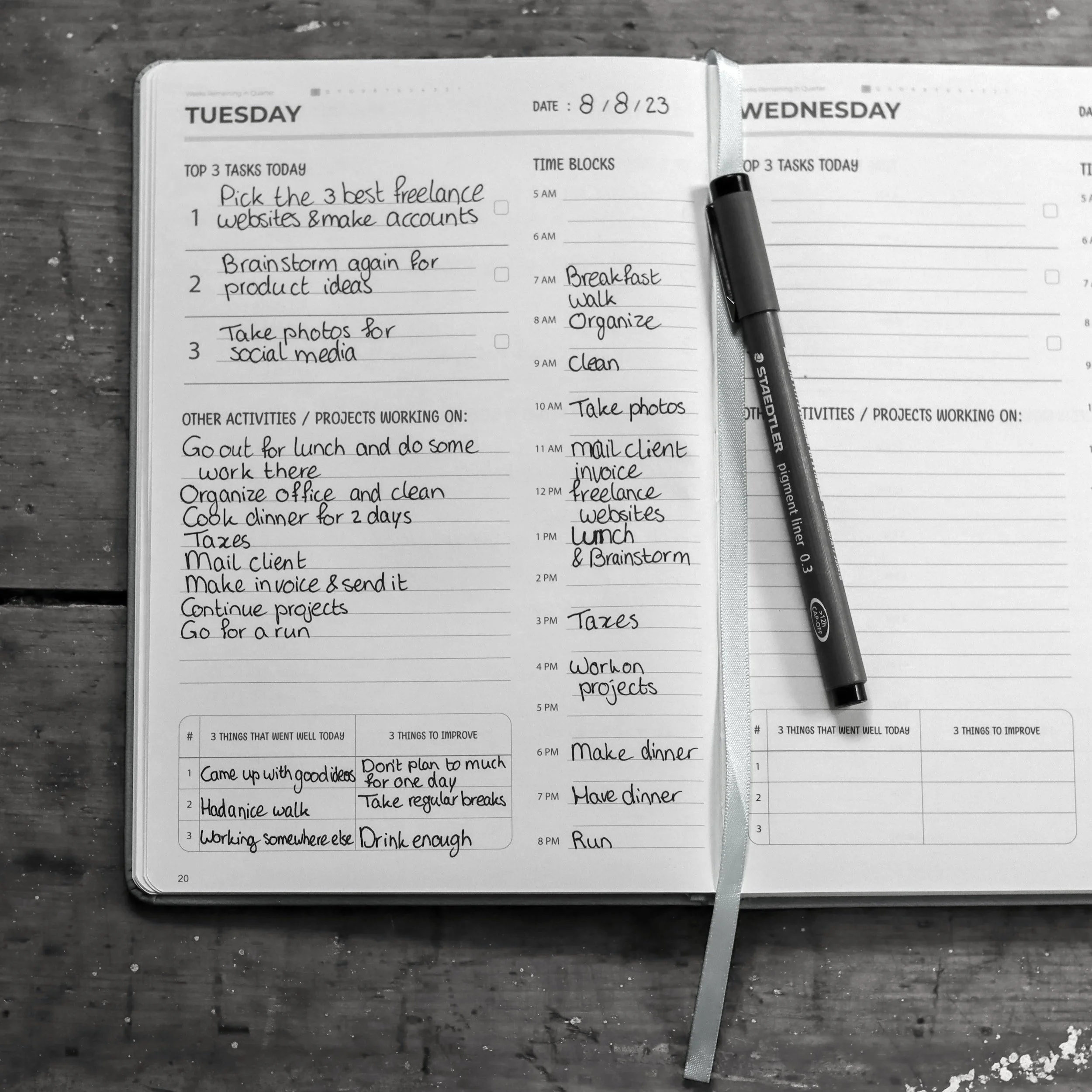
Beyond To-Do Lists: Finding Your Rhythm with Intentional Task Management
A standard to-do list is a record of what's outstanding. It rewards completion but punishes everything else by simply staying visible. Each unticked item becomes a small, accumulating signal that you're behind. Over time the list stops feeling like a tool and starts feeling like a verdict.
Mindset: the forgotten superpower
Somewhere along the way, mindset got flattened into a slogan. Stay positive. Good vibes only. Change your thoughts, change your life. It ended up printed over sunsets and stitched onto cushions, and in the process something genuinely powerful was quietly hollowed out. We started treating mindset as a mood to perform rather than a lens we look through — and a lens, once you forget you are wearing it, shapes everything you see without you ever noticing.

Agency in the Gaps: Leadership When You Have No Time Left to Give
The familiar advice that leaders must look after themselves first lands flat when there are no spare moments to allocate. The deeper issue isn't willpower or commitment. Leadership in this mode quietly strips your sense of agency. You become responsive, reactive, available. The shape of your day is set by other people's needs, and somewhere along the way you stopped noticing that choice was still on the table.
Reclaiming agency doesn't require finding more time. It requires noticing where choice already lives.